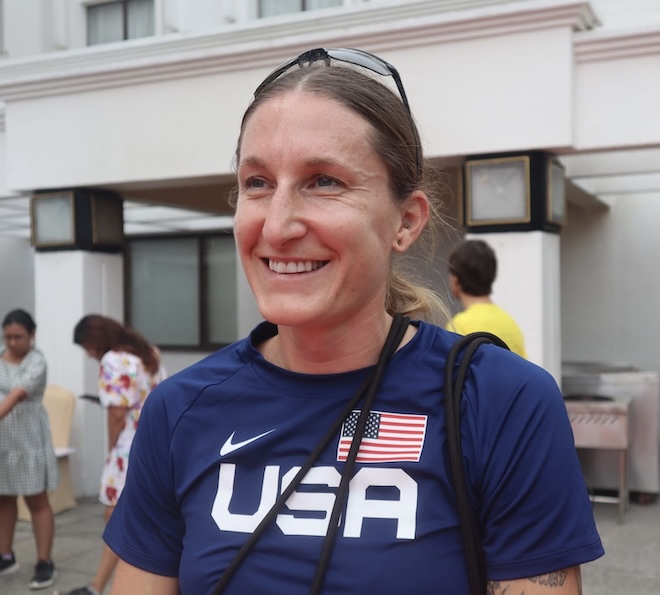
Courtney Marie Olsen
From her first appearance on the world stage in 2019 to setting a world record in 2024, Courtney Marie Olsen has steadily built one of the most impressive résumés in American ultrarunning. Based in Bellingham, Washington, Olsen has represented Team USA at multiple international championships and become known for her versatility across the marathon, 50K, 50-mile, and 100K distances.
Her international debut came in 2019 at the IAU 50 km World Championships in Romania, marking the beginning of her rise in the sport. She returned to global competition at the IAU 100 km World Championships in Germany in 2022, where she finished fourth individually and helped lead Team USA to the women’s team gold medal. In 2023, she raced at the IAU 50 km World Championships in India, gaining valuable experience against the world’s best, and followed that up with another strong showing at the IAU 100 km World Championships in 2024.
2024 was a defining year for Olsen. In November, she ran 5:31:56 at the Tunnel Hill 50 Mile in Illinois — setting a new women’s world best for 50 miles and breaking a record that had stood for more than three decades (Ratified April 2025). Earlier in the year, she claimed a third-place finish at the Comrades Marathon in South Africa, showcasing her strength across a variety of ultradistance formats. For her 2024 performances, she was ranked #6 female in the voting for “UltraRunner of the Year” by UltraRunning Magazine.
Now, as she prepares to represent Team USA once again at the IAU 50 km World Championships this December, Courtney reflects on the lessons learned from racing across continents, how she balances elite performance with community roots, and what continues to fuel her remarkable momentum.
Q&A: Courtney Marie Olsen
Q1. Courtney, you’re preparing to represent Team USA again at the IAU 50 km World Championships this December. How does it feel to be heading back to the world stage?
I am three parts honoured, curious and irritated. Making world teams is always a high priority of mine; I consider it a team event first, with individual performance secondary, and all aspects of Team motivates me. Curious because I’ll be coming into this World Championship having run Tunnel Hill 4 weeks prior and irritated because I think racing at this level in New Delhi is detrimental to our health. After the first 50K in Hyderabad I swore I wouldn’t go back to India, and here I am saying Yes a 3rd time. I want to say this is going to be it for me, so long as it’s in India, but I distrust myself. Every time I’ve raced there, I’ve come away with injury; if this becomes a 3-for-3, I can be marked as Insane.
Q2. You’ve now competed in several World Championships — Romania in 2019 (50K), Germany in 2022 (100K), India in 2023 (50K), and India again for last year’s 100K Worlds in 2024. What have you learned from those experiences?
I’ve acquired many lessons in how these work, what to expect, and what to prepare for. The biggest thing I’ve learned is to expect nothing and hope for the best. That might sound negative, but courses have changed weeks before the event or during the event, a closed course might not be, aid station supplies might run out…I’m really selling this. However, a person who isn’t afraid of being hit by a car, bit by a wild dog or missing hydration is a hopefully unemotional, steady, savvy person.
Q3. Romania in 2019 marked your international debut. What do you remember most about that first experience racing for Team USA?
Romania was special: a ski resort in summer in Brasov. 14th century Gothic churches. Swordfights in thick woods. A background haunt of vampire. Spectators lined the course smoking cigarettes. The promise of an Aperol spritz truck near the finish. It was my first time at the distance (50K), having made the team off my marathon time. I finished the race in stride with my friend and teammate Liz Eder-Northern. The team took silver. Everything was novel. What I loved most was that I’d likely never have gone there and experienced that way of living, the culture, or seen the Biserica Neagra, had it not been for making that team.
Q4. The 2022 100K World Championships in Germany was a huge milestone — finishing fourth individually and helping the U.S. women win team gold. How did that performance shape your confidence going forward?
At the IAU 100K World Champs in Berlin, I played with the idea of going for the American Record (7:00:48, held by Ann Trason). I remember someone saying, “That won’t be done today,” which further fostered my desire. But this was new territory for me, and I wasn’t naïve or confident enough to think it possible, yet. I was healthy, hungry, and wanted better for myself and the team than what we’d achieved at 50K Worlds in Romania.
They’d run out of water at an aid at a pretty pivotal point deep into the race; we also found out mid-race that the course had been measured short, and that they’d need to add an extra half mile at the finish where we’d be subjected to a few more 180’s around cones. These things could have derailed one or many, but whatever emotions I felt then only fuelled momentum towards the finish where I passed a competitor in the last 800m, moving into 4thposition. It would have been sexier had it been 3rd, but it was still a great performance for me, and I got closer to that desired timeframe of a sub-7:00 100K. What’s annoying is this is a perfect example of how you need to race all the way to the line because you never know what can happen. You asked about confidence going forward – I believe, what I learned, is that you can never count me out. I’m lurking. I’m a confident lurker.
Q5. Competing in such different environments — from the heat of India to the cooler conditions in Germany — how do you adapt your training and race strategy for international events?
I like a challenge. The thing with India is that because it’s been there the last several iterations and will remain so for years to come in the 50K, a repeat racer can apply firsthand knowledge. The hard thing with India is that as much as you try to prepare for the heat & humidity, you will never escape or be prepared for the air quality. It is very frustrating. The most one can do is train in a mask, and train to race in a mask, or suffer sans mask.
Adaptations in my training might alter slightly for the specifics of the environment, but I operate on more of a through-line year-round, wherein I incorporate a little bit of everything so I’m a degree prepared for anything at any time. Race strategy is more customized. Stubbornly, I want to run the times I want to run and have trained for, but I’ve learned that these Championship courses & the environments that withhold them are, generally, not the right courses or right environments to run fast. They’re meant for being concise, for visibility and aid station ease. There’s always cones, 180’s, and short loops. The momentum is disjunctive. This, the heat, humidity, air quality, all factor into strategy. I just try to get as fit or as recovered as possible, loosen the reins on times/pacing in the race, and instead focus on position.
Q6. You’re coming off an incredible 2024 season — a 50-mile world best at Tunnel Hill and a third-place finish at Comrades. How have you processed a year with so many major accomplishments?
Last year was vivacious; harboured a lot of dualistic feelings. I raced my first Comrades planning on being a student of it, believing myself a poor climber and then, with 10K to go, I moved into 3rd, and felt alight in love by the people of South Africa & those closest to me. I think I surprised us. In an interview after, the reporter asked, “Who are you?” Followed by, “How old are you?” I thought this might make my sponsor proud, but it didn’t. After, I was itching to move on the momentum of that result. I asked my sponsor for help with a World Record attempt at Tunnel Hill and instead was told I’d be let go 2 weeks before the attempt (mind you I’d still be with them through the end of the year). I went into Tunnel Hill not so much mad, but full of a curiosity to see who I’d be with the weight of that on me, knowing full well it was always only for me. You get used to not feeling supported, make it your schtick, and in making it your schtick, can continue doing what you’re doing sans support. I liked the me that showed up that day. Easier said when you succeed, however.
When I ran the 50 Mile World Record at Tunnel Hill, I felt a sense of growing confidence, relief, felt consistent, thought I’d elevated. I work full time, I take a loss in income to travel to races because I don’t have enough PTO, I’d lost resources, and I’d done it despite. I felt a great outpouring of love, but I also felt the vapid nature of it, the likely brevity. I knew that even though it felt good then, I’d surely disappear into the ether if I weren’t a constant on the radar of excellency happening all over, all the time. Or if I didn’t capitalize and make that result my whole personality. I don’t like the “you’re only as good as your last good result” kind of thing, nor the pressure to have a story you need to share to be visible to help garner resources to help someone sell something. It robs. I rob myself enough already.
Though my sponsor might not have understood my worth (or as they like to say, “moved in another direction, nothing personal”), I thought someone surely would after last year. And then I played a bit of the game, and it was Ew. I know I’m cornering myself, but I don’t care to play a game like that. I’m not into ghosting, false promises, stock statements, engaging with athletes who operate under a scarcity mindset, afraid to help, connect or share for fear of their losing a small piece of the pie. I think I’ve affixed a severe ideology to my experiences last year, but I also think, that if all that I accomplished last year did not warrant a contract, then I don’t see what else will. Timing is important, yes. Race choices. Results. Visibility. Reach. Youtube. Podcast. I get it. I was born poor and I’ll race poor. You can see where my heads at – proud, thoughtful, irritated, let down, further independent – a myriad. This is all likely overthinking and speaking from a place of ego. It’s just running. But in today’s running, it feels way more than just running. This is the processing.
Q7. The 50K distance sits in an interesting place — faster than a 100K but still longer than a marathon. How do you approach training and pacing for that unique challenge?
I do marathon-style training for basically all distances I race, save for I’ll slow down some of the workout paces, and add in some longer efforts or back-to-back long runs to better prepare for the specific distance. I like to keep speed around because I enjoy it, but also because I’ve got it in mind to go after another Olympic Trials marathon, and also because you need to be fast as hell in any distance these days. I’ve spent many years working on being healthy at a higher volume.
Q8. You’ve represented Team USA multiple times now. What does that team environment mean to you personally?
I’m big on team. I get more out of myself knowing it’s for a larger entity than I’d ever get racing for myself. My favourite teams to be a part of are the ones who wait at the finish line for you to come in, who like to celebrate after, who want to meet up prior to or post Championships to experience a new city, people, food. There can be independents, who think differently, who focus on their personal result over the team’s, I value them, so long as if their personal performance evolves, they have secondary goals to help the team. I’m saying Yes to India for a 3rdtime, I’m flying 25-30 hrs each way, putting myself at risk, it costs a lot of money, I lose a lot, and I’m like, Hell yeah sign me up.
Q9. How does the camaraderie and shared experience of racing with Team USA influence your own performance on race day?
It bolsters it, makes me stick it out in tough situations even if the smarter thing to do would be to drop. I’ve laid myself on the knife more than not; have finished with 2 calf tears, another time I thought I was breaking my leg, and I’ve peed brown-black in testing post-race. Pushing yourself to this level is not wise & I wouldn’t advise it. It’s not like we come back home & everyone is jazzed we medalled. We’ve medalled every team I’ve been a part of…so this serves as a sick perversion of individual measurement of success, largely inspired by the concept of Team.
Q10. You’ve helped build the Bellingham Distance Project into a strong running community. How has being part of that group influenced your development as an athlete?
I’m proud of it. A small group of us started it 12 years ago as a means of providing a place for post collegiate athletes who were competitive but perhaps not competitive enough to be sponsored, and who didn’t want to give up seeking the best of themselves in the sport. There was hardly a place to support such athletes back then. We created it because we needed it. It could be so much more, but rests largely on the shoulders of people with robust schedules. Managing a club of 30+ people, while working full time, and training/racing competitively is challenging. They get the least of me when I want to give them more, so for me it’s about hoping to keep it moving until I have more time and then making it more powerful & supported once I do.
The team consists of a variety of specialties from track 800’s to 200 milers; there’s always something to be gleaned or inspired by, and it keeps my own development fresh because I get to inhabit a little bit of each of their worlds.
Q11. Between international racing, record-setting performances, and community involvement, how do you maintain balance and perspective?
I’d say I’m on the verge of delirium more often than not. I cannot read stress unless it shows up physically. I say yes to everything for a sense of escapism & adventure, but that really just adds more to the plate. I think a combo of ADHD & high-functioning depression aids, and I think balance is an illusion or a moving target. At the root, I want to feel everything and experience as much of the world as I can while I’m in it.
Q12. What’s your mindset like in the final weeks leading up to a major championship race?
What’s been fun the past few Championship iterations is that I’m operating under delusions of grandeur AND from a place of complete surrender. I’ve raced near all of them with a lot on my legs, having raced something I consider my “A” to its “B.” I am eyes wide open willing to take whatever comes. Whatever I’ve done to get myself to that start line is an experiment, and the result it proffers is a wonder. There’s great fun in it. The disservice to myself & my team in this sort of season planning is that I am not fresh. But then, I’m stubborn, and I enjoy the challenge of trying to do back-to-back road ultras. My mindset is: One thing at a time. Recover hard. Ask for help. Indulge. Explore the limits of my being. Expand the limits of my being.
Q13. After the 50K Worlds in December, what’s next on your competitive horizon heading into 2026?
It will not be easy, but if I can manage it I want to spend a few months in South Africa, focusing on 2 Oceans & Comrades. Aside from these, or if I can’t manage both, I’ve always wanted to run my local beloved Chuckanut 50K, JFK, and/or I’ll wait with bated breath on where the ‘26 IAU 100K World Champs will be. I’m fairly flexible on next year’s schedule.
Q14. You’ve raced successfully across so many distances — from the marathon to the 100K. Do you have a favourite, or one that feels most natural to you?
I’d say my sweet spot is that 50 Mile – 100K. There’s something around the Marathon-50K I don’t think I nail despite looking at it/training from many angles. Something with the pacing, processing, fuel intake is best realized for me at the longer distances despite having a short distance/speed background. It makes me curious about the 100 mile.
Q15. When you look back at your progression from collegiate steeplechase runner to ultramarathon record holder, what stands out as the biggest turning point?
It might be making that first world team in 2019. It offered a line, a way towards betterment, professionalism & International competition I didn’t know was available to me. Another was when I ran on the US team in 2020 for the IAU 6-HR Solidarity Run. I ran around this lake here in Bellingham called ‘Lake Samish, accumulating around 53 miles, and from that experience thoughts of American and World Records sprouted. If I can run around a lake for 6 hours out of solidarity, I’m pretty sure I’m either weird or full of internal motivation. Assuredly both.
Q16. In 2024 you were ranked #6 female in UltraRunning Magazine’s UltraRunner of the Year voting. What does that recognition mean to you?
To break into that ranking system with a speciality outside the trail lens was cool. It was lovely to be ranked among that incredible group of people. It continued a conversation around the importance or intrigue (or not) of road ultrarunning and “road tax.” I’m of the belief that there’s room for all specialties, but for sensible, albeit narrow reasons, trail holds highest glory.
Q17. What continues to drive you — is it the competition, personal growth, or the pursuit of something deeper?
My why has always been about self-exploration & self-improvement. That doesn’t have to regard bettering times & places, though those are valuable to me, rather, it’s about exploring & expressing all aspects of myself and seeking a state of presence & living fully to get the most out of this life, and to combat my natural default, which seems to be depressive. I’m an almost-hedonist.
Thanks Courtney for a very open and informative interview. Good luck with your final preparations for the IAU 50K World Championships in New Delhi, India.
John O'Regan,
Director of Communications.